Monday, May 15, 2006

Mormon Tea


Mormon Tea
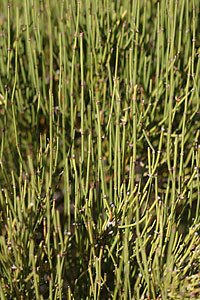
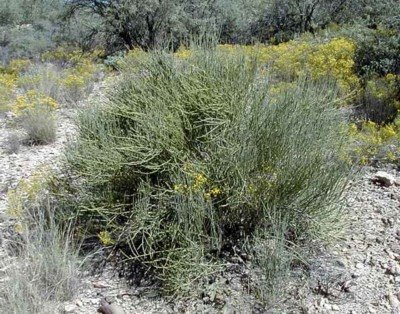
Family: Gnetaceae Genus Ephedra Common names: Mormon Tea, Brigham Tea, Cowboy Tea, Whorehouse Tea, Squaw Tea, Canyon Tea Indian names: Tuttumpin (Paiute), Tutupivi (Kawaiisu) Distribution: All of the southwestern United States and Mexico. Found in deserts and on dry mountain sides. Description: a branched broomlike shrub growing up to 4 feet tall, with slender, jointed stems. The leaves are reduced to scales and grow in opposite pairs or whorls of three and are fused for half their length. Male and female flowers, blooming in March and April, are borne on separate plants in conelike structures. They are followed by small brown to black seeds.
Indians
The Indians prepared Ephedra as a tea for stomach and bowel disorders, for colds, fever, and headache. The dried and powdered twigs were used in poultices for burns and ointments for sores. One tribe made a decoction of the entire plant and drank it to help stop bleeding.
Pioneers
Early Mormon settlers, who abstained from regular tea and coffee, drank the beverage made from this plant. A handful of green or dry stems and leaves were placed in boiling water for each cup of tea desired. It was removed from the fire and allowed to steep for twenty minutes or more. To bring out the full flavor, a spoon of sugar or some strawberry jam was added depending on individual taste. Other white settlers used a very strong tea of the plant for the treatment of syphilis and other venereal disease, and as a tonic. It was standard fare in the waiting rooms of whorehouses in early Nevada and California. It was said to have been introduced by a Jack Mormon who frequented Katie’s Place in Elko, Nevada during the mining rush of the last century. Although not as potent as the commercial relatives in China and India, the southwestern species contains enough ephedrine-related alkaloid ingredients to make it functional. The drug ephedrine is a stimulant to the sympathetic nerves and has an effect on the body similar to adrenaline. It has a pronounced diuretic and decongestant effect and was used wherever urinary tract problems occurred.
Friday, May 12, 2006

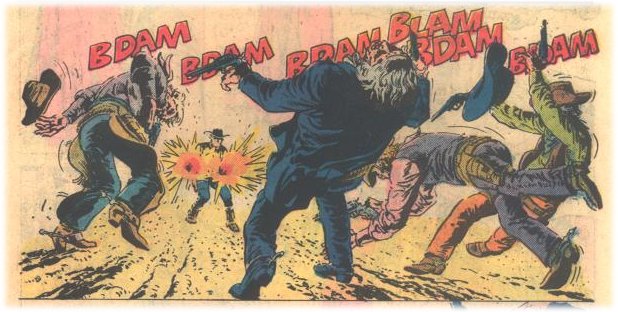
Jonah Hex Showcase ~ DC Comics (1971-1976)


Jonah Hex Showcase ~ DC Comics

He was a hero to some, a villain to others; and wherever he rode, people spoke his name in whispers. He had no friends, this Jonah Hex, but he did have two companions: one was death itself … the other … the acrid smell of gun smoke.
Witness the earliest adventures of DC’s legendary gunslinger as chronicled by writers John Albano and Michael Fleisher with captivating art by Tony DeZuniga, Doug Wildey, Jose Luis Garcia-Lopez and others.
BONUS: The complete adventures of Outlaw, a man out to clear his name, by master comics writer Robert Kanigher and art by Dezniga, Gil Kane and Jim Aparo.

It's not quite clear if Jonah Hex is supernatural or not. Many of the original "Weird Western" Comics from the early 1970's seem to suggest "Twilight Zone" style stories similar to the DC's "Weird War" series. Hex was really more of a Clint Eastwood/Man with no name character; a bounty hunter that spoke little dialouge and killed men every issue. Check your local comicbook store or the internet for this DC comics "Showcase" book of reissued Wierd Western/Jonah Hex stories from 1972 to 1976. It Retails for $16.99 and is over 500 pages...

Thursday, May 11, 2006

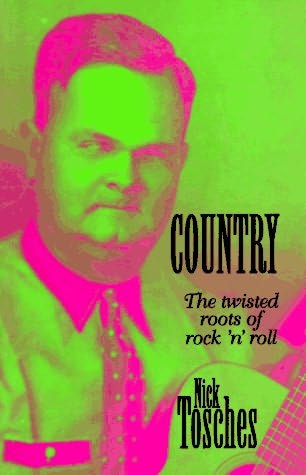
Country: The Twisted Roots of Rock 'n' Roll by Nick Tosches


Nick Tosches first book reads like a pile of notes with one chapter and topic jumping to the next without any real continuity, not unlike one of those “bathroom readers” or “book-of-lists” books that are so popular.

Tosches, focusing on sex, racism, drugs, and death, tells country & western's musical legacy through the history of yodeling cowboys, yodeling, Emmett Miller, black-face minstrel shows, black country musicians, sexual metaphors, “coon” songs, the fiddle, the electric guitar, the lap steel, the steel guitar, the pedal steel, Jerry Lee Lewis, Sun Records, western-swing, honky-tonk, rockabilly, the Nashville sound, record labels, Reb Rebel Records, radio stations, disc jockeys, and more.

Tosches takes Sun Recording artist Warren Smith’s song “Black Jack David” and traces it all the way back to the birth of Christianity in ancient Rome. I wish it was longer and more in depth becasue I was literally reading this in my truck while stopped at red lights...

Wednesday, May 10, 2006

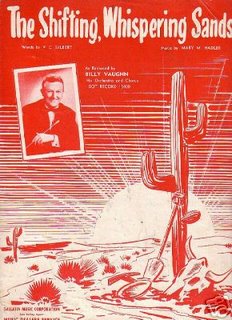
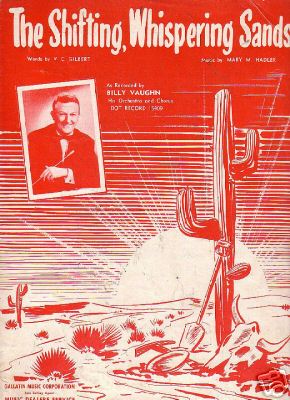
The Shifting, Whispering Sands (Gilbert/Hadler)


The Shifting, Whispering Sands
(Lyrics-V. C. Gilbert/music-Mary M. Hadler)
I discovered the valley of the shifting, whispering sands
While prospecting for gold in one of our western States
I saw the silent windmills, the crumbling water tanks
The bones of cattle and burros,
picked clean by buzzards
Bleached by the desert sun
I stumbled over a crumbling buckboard nearly covered by the sands
And stopping to rest, I heard a tinkling, whispering sound
Then suddenly realized that even though the wind was quiet
The sand did not lie still
I seemed to be surround by a mystery
So heavy and oppressive I could scarcely breath
For days and weeks I wandered aimlessly in this valley
Seeking answers to the many questions
That raced through my fevered mind
Where was everyone?
Why the white bones?
The dry wells?
The barren valley where people must have lived and died
Finally I could go no farther
My food and water gone
I sat down and buried my face in my hands
And resting thus, I learned the secret
Of the Shifting, whispering sands
How I managed to escape from the valley I do not know
But now to pay my final debt for being spared
I must tell you what I learned out on the desert
So many years ago
When the day is awfully quiet
And the breeze seems not to blow
One would think the sand was resting
But you'll find this is not so
It is whispering, softly whispering
As it slowly moves along
And for those who stop and listen
It will sing this mournful song
Of sidewinders and the horn toads
Of the thorny chaparral
Endless sunny days and moonlit nights
The coyotes lonely yell
Of the stars seem you could tough them
As you lay and gaze on high
At the heavens where we're hoping
We'll be going when we die
Yes it always whispers to me
Of the days of long ago
When the settlers and the miners
Fought the crafty Navajo
How the cattle roamed the valley
Happy people worked the land
And now everything is covered
By the shifting, whispering sands
How the miner left his buckboards
Went to work his claims that day
And the burro's broke their halters
When they thought he'd gone to stay
Wandered far in search of water
On to old sidewinder's well
And there, their bones picked clean by buzzards
That were circling when they fell
How they found the ancient miner
Lying dead upon the sand
After months they could but wonder
If he died by human hands
So they dug his grave and laid him
On his back and crossed his hands
And his secret still is hidden
By the shifting, whispering sands
This is what they whispered to me
On the quiet desert air
Of the people and the cattle
And the miner lying there
If you want to learn their secret
Wander through this quiet land
And I'm sure you'll hear the story
Of the shifting, whispering sands
Shifting, whispering sands

Tuesday, May 9, 2006

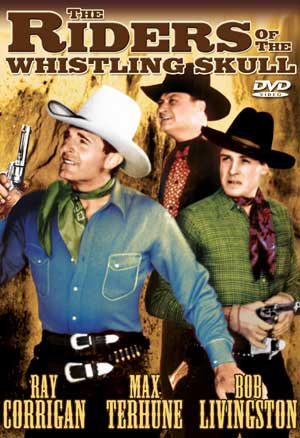
Riders of the Whistling Skull (1937)


Riders of the Whistling Skull (1937)

(Black & White) 54 minutes

I love B-Westerns. Usually low budget, aimed at depression-era pre-adolescent audiences, these films are almost always loaded with guns, horses, fights, bad guys, good guys, and sometimes a song or two by real country & western artists if you can spot them. Most B-westerns clock in at around sixty minutes, which makes for great late-night viewing when you think you might not be able to make it for two full hours.

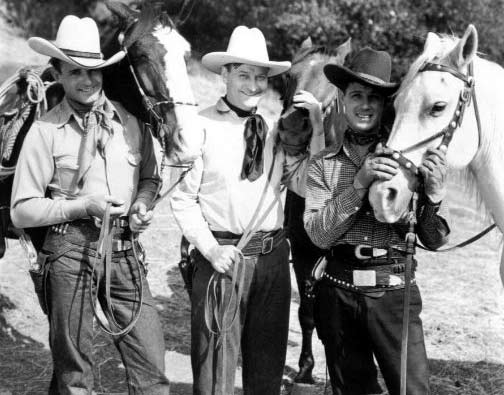
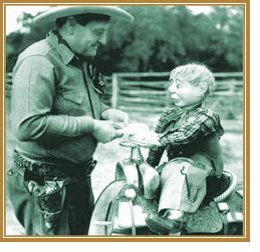
Combining western, mystery and horror elements, Riders of the Whistling Skull stars "The Three Mesquiteers"; Ray "Crash" Corrigan (founder of "Corriganville"), Robert Livingston, and Max "Alibi" Terhune (who carries around his ventriloquist dummy named "Elmer") as they help the daughter of a missing professor on an expedition to "the Lost City of Lukachukai" where her father has disappeared. They find their way to "the Whistling Skull", a strange rock formation shaped like a giant human skull, protected by a mysterious group or Indians and haunted by a tribal curse.

Riders of the Whistling Skull also features famed stunt-man Yakima Cunutt, Chief Thundercloud and according to the Internet Movie Data Base, Iron Eyes Cody in uncredited role. The DVD packaging from Alpha Video claims that the movie was filmed in "the cliffs above St. George, Utah" but it looks like some of it was shot in Red Rock Canyon State Park in California. The picture quality on this disc is not very good but I picked it up for only $4.99 at Best Buy so I can't really expect too much.

Monday, May 8, 2006

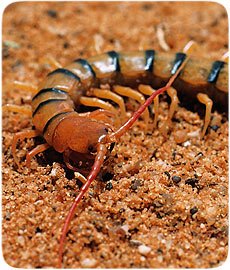
The Red Headed Centipede


The Red Headed Centipede, Scolopendra heros castaneiceps, is one of three subspecies of Scolopendra heros, which are often collectively referred to as "Giant Desert Centipedes". The Giant Desert Centipedes are some of the largest and most attractive of all centipedes, but the Red Headed Centipede is widely considered the most impressive of the bunch.

The Red Headed Centipede is a desert dweller that spends the day tucked away in moist hiding spots to avoid the desert's drying affects. They are often found in rock crevices, under leaf litter, and under rocks, and will sometimes burrow into the ground. Red Headed Centipedes are nocturnal predators that feed primarily upon insects. They are well equipped to avoid being preyed upon. This species of centipede has a tail that looks similar to its head, confusing would-be predators and thus, helping to protect its most vital areas. If it is attacked, it can respond with a very painful or even deadly bite. This species of centipede is quite fast and typically very aggressive. Although the venom of this centipede is not considered deadly to humans, all centipedes have a certain amount of venom in their bites; and while be bitten usually results in nothing more than a very painful wound, some people may be allergic to the venom. Pain from the bite may only last a couple of hours, but it could last as much as a couple of days.

The Red Headed Centipede is one of the world's largest species of Centipede and can reach 6 to 12 inches in length. They may have dark blue, purple, or black bodies with red or orange heads, and attached to each body segment is a pair of yellow legs.

The Red Headed Centipede is a relatively common species found throughout much of the southwestern United States and Northern Mexico.
WARNING! NOT FOR THE SQUEAMISH: Click here to see a youtube video of a Red Headed Centipede killing and eating a mouse.

Sunday, May 7, 2006

The Thunderbird: Myth or Reality?


The Thunderbird....

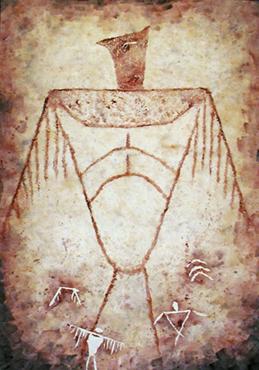
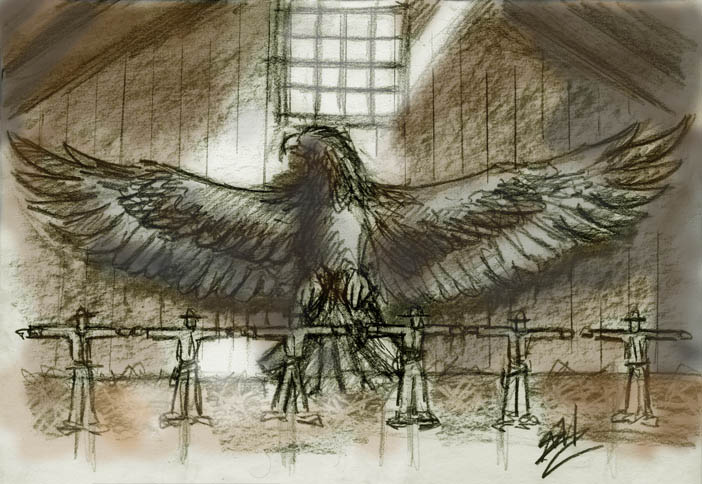
The strange case of the Thunderbird is unique in the study of unknown animals, because it contains two mysteries in one: the search for a long-lost and probably nonexistent photograph of the creature has virtually eclipsed the search for the creature itself. The Thunderbird is a part of Native American mythology in tribes of the Pacific Northwest and the Great Lakes. These giant, birdlike creatures were said to generate lightning from their eyes and to cause thunderclaps by flapping their massive wings in the sky. There are countless sightings on record of the revered supernatural entity, or a huge bird fitting its description, both by Native Americans and the "white man".
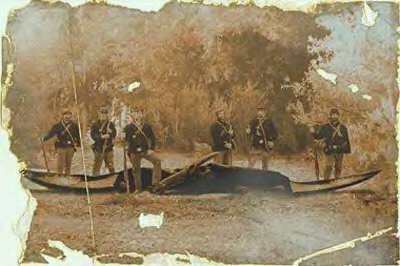
The most celebrated Thunderbird encounter took place in 1890, on the desert sands of what was then the Arizona Territory. Two cowboys had a bizarre confrontation which has varied widely in the telling, but the gist of the story is this: they saw a giant flying bird, shot and killed it with their rifles, and carried its spectacular carcass into town. A report in the April 26, 1890 Tombstone Epigraph listed the creature's wingspan as an alarming 160 feet, and noted that the bird was about 92 feet long, about 50 inches around at the middle, and had a head about eight feet long. The beast was said to have no feathers, but a smooth skin and wingflaps "composed of a thick and nearly transparent membrane... easily penetrated by a bullet." Perhaps the hardest part of this story to swallow is that two horses could manage to haul a dead behemoth like this for any distance.
Sounds like a typical tall tale of the Wild West, and that's probably what it is. But it apparently does contain a kernel of truth. In 1970, Harry McClure claimed that as a boy he knew the two cowboys from the story later in their lives, and they had told him a different version of the events. McClure said the giant bird they saw in the desert actually had a wingspan of more like 20 to 30 feet -- much more reasonable than 160, but still enormous. The two riders shot at the creature, but it was out of range. Their spooked horses refused to chase it, so the men rode into town empty-handed, carrying only news of the one that got away. The Tombstone newspaper printed its highly embroidered version of the cowboy's sighting, which was spared from fading into obscurity by its inclusion in a 1930 book on the Old West.
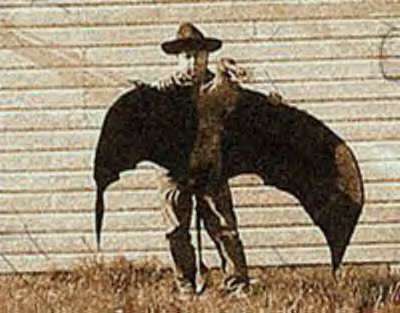
In 1963, the story came to the attention of writer Jack Pearl, who revived the tale for an article in a pulpy men's adventure magazine called Saga. As if the Epigraph report hadn't spiced up the facts enough already, Pearl liberally embellished the encounter into a dramatic rip-snorter entitled "Monster Bird That Carries Off Human Beings!"Pearl pushed the date of the encounter back to 1886, and he described the witnesses as two prospectors who killed the bird and proudly showed off their trophy in Tombstone. Pearl also added some extra conflict by telling of a how a second Thunderbird snatched up a heckler who had ridiculed the prospectors and flew away with him in its talons. But Pearl's most significant editorialization was this: he said that the Epigraph newspaper story had run with a photograph of the giant bird's carcass, nailed up to a wall with its mighty wingspan unfurled, and a number of men posing next to it for scale. This part of the legend, the Thunderbird photo, has taken on a life of its own. Pearl's fictional account of a photograph of Old West settlers with a big dead bird was picked up and repeated time and again, multiplying and evolving just as it had before Pearl ever got hold of it. In time, people who heard the story began to believe that they had previously seen the photo with their own eyes. Somehow, people felt convinced that they had once marveled at the strange picture in some old book or newspaper, often noting that they didn't realize the significance of the photo at the time, and regretting that they had not kept it. The details might differ from one recollection to the other, with some recalling the bird had feathers and others saying it looked more like a pterodactyl, and some thinking the bird was nailed to a wall and others remembering that it was held with wings outstretch by a large group of men. But no matter what the specifics, each person feels certain his or her memory is true.
Many have reported that they saw the Thunderbird photo in FATE Magazine, National Geographic, Grit, or some other similar publication, but entire archives of these periodicals have been searched, and no Thunderbird discovered. The experts in the cryptozoology field are no less susceptible to Thunderbird recollections than the common layman, with Ivan T. Sanderson and John A. Keel among those who claim to have once held the photo in their hands. Some accounts of seeing the photo are amazingly precise and hard to disregard. Larry Thomas told Strange Magazine that he saw the photo in a library in the early 1980s, as an adult, in a thin hardcover book of photography from the Old West. He says that he was so fascinated by the picture that he looked at it dozens of times over a four-year period, and he even checked the book out once so he could take it home for his wife to see. It's difficult to tell someone that an experience as vivid as that never really happened, but what is the alternative? What's the word with the Thunderbird? The best explanation for the phantom photo phenomenon is that these are memories of things that never existed. It might simply be that people have read descriptions of the cowboys and the giant bird that were so colorful and evocative that their imaginations created a near-tangible mental image of the scene. As the controversy surrounding "false memory syndrome" has demonstrated, the things we think we recall can be distorted by external suggestion, mismatched fragments of things that did happen, and maybe even debris from the collective subconscious. Some might view this line of reasoning as party-pooping skepticism, but if it's correct, what it reveals about the mysteries of the human mind is way more interesting than any big bird could ever hope to be.