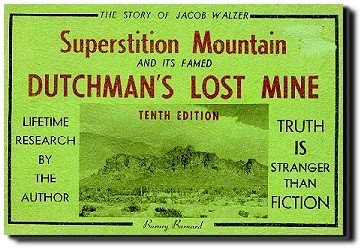
The Lost Dutchman Mine and Superstition Mountains

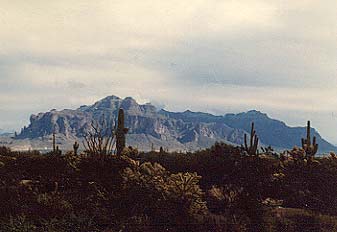
Located just east of Phoenix, Arizona is a rough, mountainous region where people sometimes go... only to never be seen again. It is a place of mystery, of legend and lore and it is called Superstition Mountain. According to history, both hidden and recorded, there exists a fantastic gold mine here like no other that has ever been seen. It has been dubbed the “Lost Dutchman Mine” over the years and thanks to its mysterious location, it has been the quest of many an adventurer... and a place of doom to luckless others.
What strange energy lingers here? What has caused dozens of people who seek the mine to vanish without a trace? Is the answer really as the Apache Indians say? Does the “Thunder God” protect this mine... bringing death to those who attempt to pillage it? Or can the deaths be linked to other causes? Are they caused, as some have claimed, by the spirits of those who have died seeking the mine before?
Let’s explore all of these questions and journey back into the haunted history of the Lost Dutchman Mine... and uncover the numerous deaths and the violence that surrounds it.
Superstition Mountain
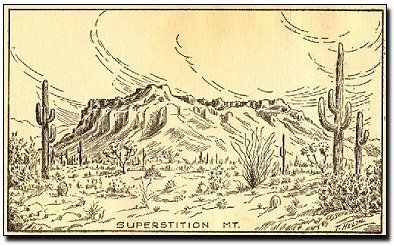
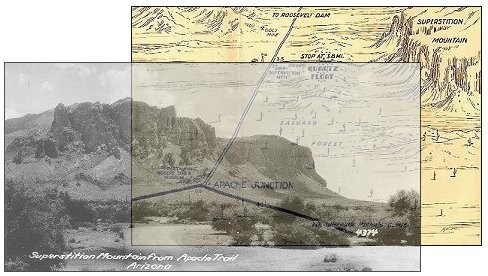
Superstition Mountain is actually a collection of rough terrain that has gained the name of a single mountain. The contour of the region takes in thousands of cliffs, peaks, plateaus and mesas and even today, much of it remains largely unexplored. Despite the tendency by many to call this a range of mountains, it is in reality, only one. It is certainly not the highest mountain in the region, but it has the reputation of being the deadliest. Over the course of several centuries, it has taken the lives of many men and women and has perhaps caused a madness in them that has encouraged them to kill each other.

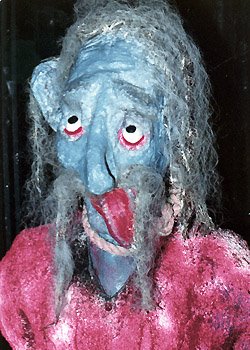
The Apache Indians were probably the first to set eyes on the mountain, followed by the Spanish conquistadors, the first of which was Francisco Vasquez de Coronado. He came north from Mexico in 1540 seeking the legendary “Seven Golden Cities of Cibola”. When he reached the region, the local Indians told him that the mountain held much gold, although they refused to help the Spaniard explore it. They were in too much fear of the “Thunder God”, who was said to dwell there, and who would destroy them if they dared to trespass upon his sacred ground.
When the Spaniards tried to explore the mountain on their own, they discovered that men began to vanish mysteriously. It was said that if one of them strayed more than a few feet from his companions, he was never seen alive again. The bodies of the men who were found were discovered to be mutilated and with their heads cut off. The terrified survivors refused to return to the mountain and so Coronado dubbed the collection of peaks, Monte Superstition, which explains the origin of the infamous name.
The mountain became a legendary spot to the Spanish explorers who followed.... and was regarded as an evil place.
The Spanish Mine
The first man to discover the gold of the Indians on Superstition Mountain was Don Miguel Peralta, a member of a prominent family who owned a ranch near Sonora, Mexico. He discovered a vein of rich gold here in 1845 while searching for the treasure described to Coronado.
Before he returned to Mexico for men and supplies with which to excavate the gold, he memorized the surrounding territory. He described the mountain’s most outstanding landmark as looking like a “sombrero”; thus he named the mine the “Sombrero Mine”.
To others, the peak, or spire, looking more like a finger pointing upwards and it has also been referred to as the “Finger of God”... except to early white explorer Pauline Weaver. He used the rock as a place to etch his name with a knife and subsequent prospectors discovered the etching and dubbed the landmark “Weaver’s Needle”. The name stuck and nearly every reference to the lost mine uses the Needle as a point of origin.
Peralta returned to Mexico and gathered men and material to work the mine. Soon, he was shipping millions of pesos in pure gold back to Sonora. It was obvious that this was a gold strike like no other.
Meanwhile, the Apache were angry over the Spanish presence on the mountain and in 1848, raised a large force to drive Peralta and his men from the area. Peralta soon got word of the impending fight and withdrew his men from the mine. They would pack up all of the available burros and wagons with the already mined ore and return home. Because he planned to return someday, Peralta took elaborate precautions to conceal the entrance to the mine and to wipe out any trace that they had ever worked there.
Early the next day, he assembled his men and prepared to move out.... but they never had a chance. Taken by surprise, the Apache warriors attacked and massacred the entire company of Spaniards. The pack mules were scattered in all directions, spilling the gold and taking it with them as they plunged over cliffs and into ravines. For years after, prospectors and soldiers discovered the remains of the burros and the rotted leather packs that were still brimming with raw gold.
The area, dubbed “Gold Field” became a favorite place for outlaws and get-rich-quick schemers, who spent days and months searching for the lost gold. The last case of anyone finding the bones of a Peralta mule was in 1914. A man named C.H. Silverlocke showed up in Phoenix one day with a few piece of badly decayed leather, some pieces of Spanish saddle silver and about $18,000 in gold concentrate.
The Blind-folded Doctor
The next discoverer of the Peralta mine was a man named Dr. Abraham Thorne. He was born in East St. Louis, Illinois and all of his life, longed to be a doctor to the Indians in the western states. Early in his life, he was befriended by the frontier legend, Kit Carson, and when Fort McDowell was founded in Arizona in 1865, he arranged for Thorne to become an army doctor with an officer’s rank.
At this time, fighting between the whites and the Apache was often fierce. The Indians were being besieged by the Army but it would not be long before cooler heads would prevail and President Abraham Lincoln would create a compromise in the area. He proposed a reservation along the Verde River, near Fort McDowell, which could serve as a sanctuary for the Apache. It was here, in an area known unofficially as the “Strip”, where Thorne came to live and work amongst the Indians. He soon made many friends and earned respect from the tribal leaders, caring for the sick and injured, delivering babies and teaching hygiene and waste disposal.
In 1870, a strange incident would take place in Dr. Thorne’s career. Several of the elders in the tribe came to him with a proposal. Because he was considered a good man and a friend of the Apache, they would take him to a place where he could find gold. The only condition would be that he was to be blindfolded during the journey of roughly 20 miles.
Dr. Thorne agreed and the Indians placed a cloth around his head and over his eyes. They led him away on horseback and at the end of the journey, the cloth was removed and he found himself in an unknown canyon. He would later write that he saw a sharp pinnacle of rock about a mile to the south of him. Treasure hunters believe this was most likely Weaver’s Needle. There was no sign of a mine, but piled near the base of the canyon wall (as if placed there for him) was a stack of almost pure gold nuggets. He picked up as much of it as he could carry and returned home. He later sold the ore for $6,000 and became another strange link in the mystery of the mine’s location.
The Dutchman
First of all, I guess we should clear up one popular misconception about Jacob Walz (or Waltz depending on the story you hear) and it’s that he was not a “Dutchman”. He was actually from Germany and born there in the early 1800’s. He came to America in 1845 and soon heard about the riches and adventure that were waiting in the frontier beyond New York. His first gold seeking took him to a strike in North Carolina and from there he traveled to Mississippi, California and Nevada... always looking for his elusive fortune.
Walz worked the gold field of the Sierra Nevada foothills for more than ten years, never getting rich, but turning up enough gold to get along. By 1868, he was in his fifties and wondering if he was ever going to find his proverbial “mother lode”. The Indians had nick-named him “Snowbeard” because of his long, white whiskers and it isn’t hard to picture him as one of those grizzled old prospectors who were so common in western films.
That same year, Walz began homesteading in the Rio Satillo Valley, which is on the northern side of Superstition Mountain. Soon after he arrived, he began to hear stories from the local Indians about supernatural doings around the mountain, about a fierce god... and about vast deposits of gold.

Most stories about Jacob Walz say that he spent the next 20 years of so prospecting for gold around the Arizona Territory. He often worked for wages in other men’s mines while he searched from his own fortune. It was during one of these jobs that he met Jacob Weiser, most likely while he was working at the Vulture Mine in 1870.
One version of the legend claims that Walz was fired from the mine for stealing gold and soon, the two “Dutchman” struck out on their own and vanished into the land around Superstition Mountain. Not long after, they were seen in Phoenix paying for drinks and supplies with gold nuggets. Some claimed this gold was the stolen loot from the Vulture Mine, while others said that it was of much higher quality and had to have come from somewhere else. Regardless of where it came from, the two men would spend the gold around town for the next two decades.
There have been a number of stories about how the men found the “lost” mine. According to some, they stumbled upon it by accident. Others say that killed two Mexican miners, who they mistook for Indians, and then realized the men were mining gold.... but the most accepted version of the story is that they were given a map to the mine by a Mexican don whose life they saved.
The man was said to have been Don Miguel Peralta, the son of a rich landowner in Sonora, Mexico and a descendant of the original discoverer of the mine. The Dutchmen saved Peralta from certain death in a knife fight and as a reward, he gave them a look at the map to the mine. He was later said to have been bought out of the mine by Walz and Weiser.
At some point in the years that followed, Jacob Weiser disappeared without a trace. Some say that the Apaches killed him, while others maintain that Walz actually did him in. (As you can see, there is a lot of speculation to the legend).
But Walz was always around, at least part of the time. Long periods would go by when no one would see him and then he would show up in Phoenix again, buying drinks with gold nuggets. It was said that Walz had the richest gold ore that anyone had ever seen and for the rest of his life, he vanished back and forth to his secret mine, always bringing back saddlebags filled with gold. Whenever anyone tried to get information out of him, he would always give contradictory directions to where the mine was located. On many occasions, men tried to follow him when he left town, but Walz would always shake his pursuers in the rugged region around the mountain.

By the winter of 1891, an old Mexican widow named Julia Elena Thomas, who owned a small bakery in Phoenix, befriended the aged miner. Apparently, they became romantically involved and Walz promised to take her to his secret mine “in the spring”.... but she never saw it. The Dutchman died on October 25, 1891 with a sack of rich gold ore beneath his deathbed.
Immediately after word reached town about Jacob Walz’s death, a number of men who had heard the Dutchman speak of the mine over the years rode out for the mountain in search of the mystery. They never found it... and in fact, two of the prospectors, Sims Ely and Jim Bark, spent the next 25 years searching in vain for what they called “The Lost Dutchman Mine”.
The search has since fueled more than a century of speculation. Theories as to the mine’s location have filled dozens of books and pamphlets. Literally hundreds of would-be prospectors have searched the Superstition Mountain region and most have come home with little more than sunburns......
But there are also many who have not come home at all.
Death and Mystery
There is no way to guess just how many people have died in pursuit of the Lost Dutchman Mine. Some who have disappeared may have just quietly slipped away, unwilling to admit that they failed to find the treasure.... while others may have gone in secretly and never came out, their names recorded as a missing persons case somewhere.
The death toll of the legendary Peralta Massacre varies between 100 to 400, plus there are the murders attributed to the Dutchman, Jacob Walz himself. He is alleged to have killed at least two men who found his treasure trove and is blamed for the death of his partner, Jacob Weiser, and others.
There are also a number of people who were slain by the Apaches after they were found searching the mountain for the mine. These deaths, like the victims of the massacre and those killed by the Dutchman, are easy to document and understand.
But there are others.... which are not so easy to explain.
In the summer of 1880, two young soldiers appeared in the town of Pinal. They had recently been discharged from Fort McDowell and were looking for work at the Silver King Mine, operated by Aaron Mason. They also asked him to take a look at some gold ore they had found while crossing Superstition Mountain. Mason was stunned to see a bag of extremely rich gold ore. Where had they found it?
The soldiers explained that they had been on the mountain and had flushed a deer into one of the canyons. On their way out, they found the remains of an old a tunnel and mine. This small bag of gold was only a little of what could be found there.
Mason asked them if they could find the place again and they believed they could, having been scouts for the Army and very conscious of the details of the landscape. They remembered the mine being in the northerly direction of a sharp peak (which Mason was sure was Weaver’s Needle) and in very rough country. A narrow trail had led from the peak and into the valley where they found the mine.
The soldiers admitted however, they knew little about mining. Would Mason go into partnership with them? He agreed and purchased the ore they brought with them for $700, then helped them get outfitted for their return to the mine. They left Pinal the next day... and never returned.
Mason waited two weeks and then sent out a search party. The nude body of one of the soldiers was found beside a trail leading to the mountain. He had been shot in the head. The other man was found the next day and had been killed in the same manner. Apaches? No one would ever find out...
A year later, a prospector named Joe Dearing showed up in Pinal and worked as a part-time bartender. After hearing about the death of the two soldiers, he began to make searches of the Superstition, looking for the mysterious mine. He was more successful in his search than most, although I don’t think I would go as far as to say his luck was any better.
According to Dearing, he had discovered the mine and that it “was kind of a pit, shaped like a funnel and with a large opening at the top”. He said that the pit had been partially filled in by debris and there was a tunnel that had been walled over with rocks. Dearing planned to work as a bartender until he could make enough money to excavate his find.
He later went to work at the Silver King Mine, still intent on saving his earnings.... until a cave-in killed him a week later.
Another prospector connected to the Lost Dutchman Mine and its mysterious deaths was Elisha Reavis, better known as the “Madman of the Superstitions”. From 1872 until his death in 1896, he resided in a remote area on the mountain and raised vegetables. The local Apaches never bothered him because they were afraid of him. The Indians held those who were mad in superstitious awe and Reavis certainly seemed to fit the bill. It was said that he ran naked through the canyons at night and fired his pistol at the stars.
In April of 1896, a friend of Reavis realized that he was overdue for his periodic trip into town and went in search of him. His badly decomposed body was found near his home. Coyotes had eaten him and his head had been severed from his body (much like the Spanish conquistadors). It was found lying several feet away.
The same year that Reavis was found murdered, two Easterners went looking for the mine. They were never seen again.
Around 1900, two prospectors, remembered only as Silverlock and Malm, began an excavation on the northern edge of the Superstition. They found some of the gold remaining from the Peralta Massacre, but little else. For some reason though, they remained working the area for years after, sinking dozens of shafts and finding nothing.
Then, in 1910, Malm appeared at the Mormon cooperative in Mesa. He was babbling incoherently that Silverlock had tried to kill him. Deputies brought the man in and he was judged insane and committed to the territorial asylum. Malm was later sent to the county poor farm, none too steady himself, and both men died within two years.
What was it about the Superstition that unbalanced these men?
Also in 1910, the skeleton of a woman was found in a cave, high up on Superstition Mountain. Several gold nuggets were found with the remains. The coroner judged the death to be of recent date although no further information about her was ever found. And the gold nuggets were never explained.

In 1927, a New Jersey man and his sons were hiking on the mountain when someone began rolling rocks down on them from the cliffs above. A boulder ended up crushing the legs of one of the boys. The following year, a person rolling huge rocks down on them also drove two deer hunters off the mountain.
In June of 1931, a government employee named Adolph Ruth from Washington, D.C. left for the Superstition foothills with what he claimed was an old Peralta map to the mine. When a search party went to look for him a few days later, his campsite was found to be intact, but Ruth was missing. That December, his skull was found on Black Top Mountain with two holes in it. The rest of his skeleton was found a month later, about three-quarters of a mile away. In his clothing was a cryptic note that read “About 200 feet across from cave” and “Veni, Vidi, Vici” (I came, I saw, I conquered). There was no trace of the treasure map. Law enforcement officials attributed his death to sunstroke or suicide....
In December 1936, Roman O’Hal, a broker’s clerk from New York City died from a fall while searching for the mine. It was believed to have been an accident.
In 1937, an old prospector named Guy “Hematite” Frink came down from the mountain with some rich gold samples. That following November, he was found shot in the stomach on the side of a trail. A small sack of gold ore was discovered beside him. His death was also ruled to be an accident.
In June 1947, a prospector name James A. Cravey made a much-publicized trip into the Superstition canyons by helicopter, searching for the Lost Dutchman Mine. The pilot set him down in La Barge Canyon, close to Weaver’s Needle. When Cravey failed to hike out as planned, a search was started and although his camp was found, Cravey was not. The following February, his headless skeleton was found in a canyon, a good distance from his camp. It was tied in a blanket and his skull was found about thirty feet away. The coroner’s jury ruled that there was “no evidence of foul play.”

In February 1951, Dr. John Burns, a physician from Oregon, was found shot to death on the Superstition. It was said to have been an accidental death.
In early 1952, Joseph Kelley of Dayton, Ohio began his own search for the mine. He was never seen again... until his skeleton was discovered near Weaver’s Needle in May of 1954. He had been shot directly from above and according to the coroner’s jury, “by accident”.
Two California boys hiked onto Superstition Mountain the same year as Kelley. Nothing further was ever seen of them. Some have suggested that they met the same fate as the three Texas boys who had also disappeared a few years before.
In January 1956, a Brooklyn man reported to police that his brother had been missing for several weeks. It was believed that he had gone in search of the mine. His body was found the next month and a bullet hole was discovered above his right temple.
In April of 1958, a deserted campsite was found on the northern edge of the mountain. There was a bloodstained blanket, a Geiger counter, cooking utensils, a gun-cleaning kit, but no gun, and some letters from which the names and addresses had been torn. No trace of the camp’s occupant was ever found.
In October 1960, a group of hikers found a headless skeleton near the foot of a cliff. The skull was found four days later was it was determined that it belonged to an Austrian student named Franz Harrier.
Five days later, another skeleton was found and in November, police identified the body as William Richard Harvey, a painter from San Francisco. His cause of death was unknown.

In January 1961, a family picnicking near the edge of the mountain discovered the body of Hilmer Charles Bohen buried beneath the sand. He was a Utah prospector who had been shot in the back.
Two months later, another prospector, Walter J. Mowry from Denver, was found shot to death in Needle Canyon.
That fall, police began searching for Jay Clapp, a prospector who had been working on the Superstition on and off for about 15 years. He had last been seen in July..... the search was eventually called off. His headless skeleton was finally discovered three years later. He was identified by two cameras with the initials “JC” scratched on them.
And with that, my record of mysterious deaths comes to an end, although the death of Jay Clapp was far from the last. Over the years, there have been many who have sought the gold of the Dutchman and who have never returned.
If you are thinking of trying it for yourself, make sure that you follow the advice of prospector and cowboy Barney Barnard, an expert on the Lost Dutchman Mine (if such a person exists):
1. If you are a citizen of the United States, you have the legal right to search for the mine.
2. Do not buy any maps that claim to show its location. There is no map in existence.
3. Do not go onto the mountain alone. Go in pairs at least and go armed. Shoot only to protect your life.
4. Take plenty of water and carry only light, condensed food.
5. Establish a central camp and work in every direction from it.
As you can guess from the narrative that preceded this list, Barnard never found the Lost Dutchman Mine and has neither has anyone else. It is still out there somewhere in the rugged hills of Arizona, just waiting for someone to return and claim its prize.
But is something else waiting out there too? Something that watches over the mine, or even the mountain itself, waiting for the unsuspecting interloper to dare and trespass on what the Apache believed was sacred ground?

Perhaps the prospector named Joe Dearing said it best when he described the mine as “the most God-awful rough place you can imagine... a ghostly place.”
It is certainly a haunted spot. Haunted by an unknown energy that claims the lives of men? Haunted by the ghost of the Dutchman, Jacob Walz? Or haunted by the spirits of the countless men and women whose lives have been taken because of it?
That answer is as mysterious as the location of the Lost Dutchman Mine itself......


 mini-mart.