Wednesday, August 9, 2006

The Iroquois False Face Society


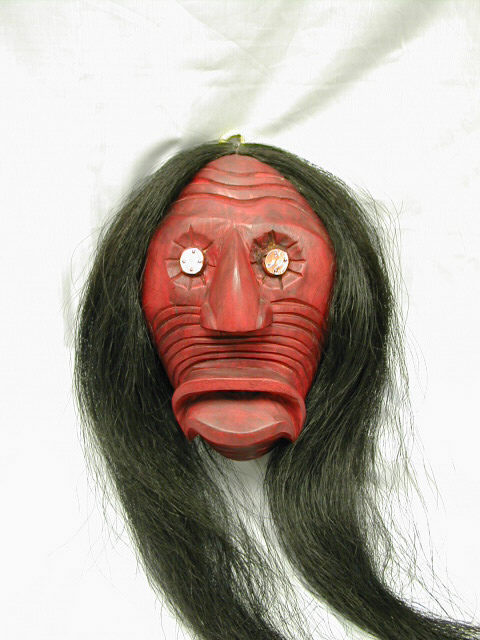
The Iroquois of the eastern Great Lakes area made a wide variety of masks. The most famous are the corn husk masks of the Husk Face Society and the carved wooden masks of the False Face Society. The grimacing False Faces, which were used by the Iroquois in the curing rites of the False Face Society, are especially notable. The masks are wooden portraits of several types of mythical beings or apparitions that appeared in dreams, who, the Iroquois say, lived only a little while ago in the far rocky regions at the rim of the earth or wandered about in the forests.

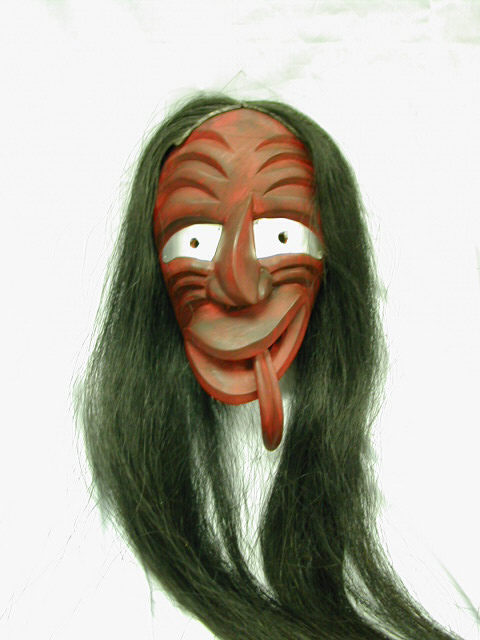
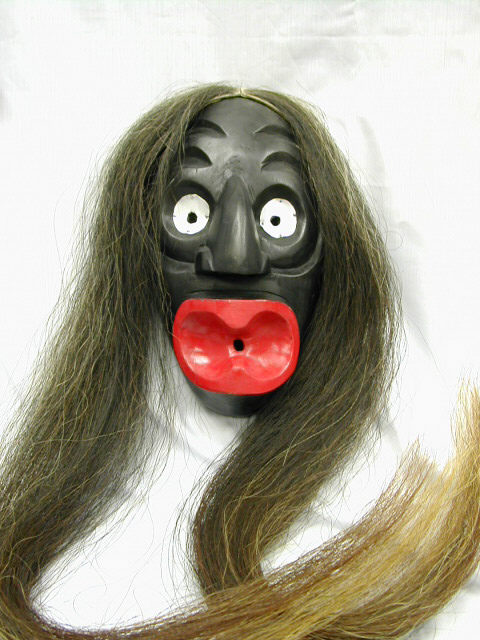
Most of these masks, which are "fed" with tobacco to keep their spirit alive, are painted red or black. They have deep set eyes which are set off by gleaming metal eye-plates and large, bent noses. The arched brows are deeply wrinkled and sometimes divided above the nose by a lengthwise crease. The mouth is the most variable feature, and runs through a whole range of expressions depending on mood, function, and locality. Sometimes it is pursed as if for whistling; sometimes it is puckered with conventionalized tongue and spoon-like lips, which may be funnel shaped to imitate blowing ashes in curing rites. Or the mouth may reveal the teeth or have a protruding tongue.
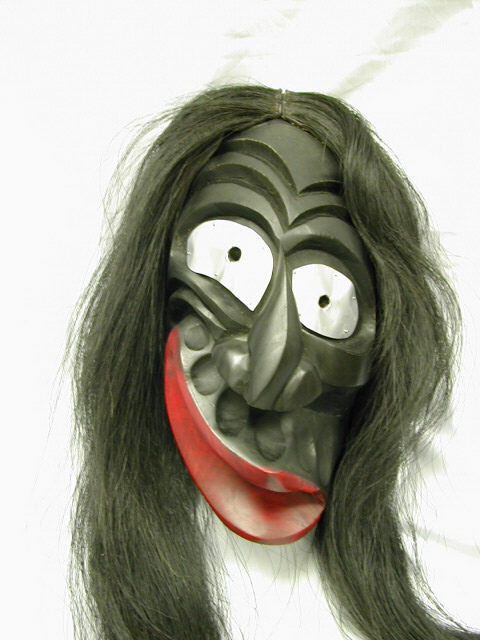
Other masks have large, straight, distended lips which may be twisted up at one corner with an accompanying bent nose, or both corners may turn down in a distorted arrangement producing a frightening effect. A series of wrinkles usually heightens the distorted look and cheek bones are sometimes suggested. A prominent chin, common to some masks, is used as a handle for adjustment by the wearer .

The faces are framed by long hair usually cut from black or white horses' tails, which fall on either side from a central part. Before the Europeans introduced horses, corn husk braids, or tresses of buffalo mane served as hair.
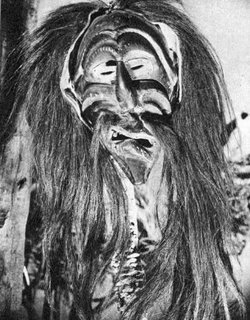
The significance of the masks to the Iroquois lies not in their artistic value, but in their power. The beings they represent instruct people to carve likenesses of themselves. They say that supernatural power to cure disease will be conferred on the human beings who make the masks when they feed the masks, invoke the beings' help while burning tobacco and sing a curing song.

The False Face Society is just one of the many curing societies found among the Iroquois. And though it was not necessarily the most important, it is the best understood of all the societies because of intensive research.
Members of the society put on the false faces to visit the lodge of a sick man who has declared himself in need of a cure. With their masks on, and shaking rattles made of turtle shells, the members who are to effect the cure, creep towards the sick man's home speaking a nasal "language" . They scrape their rattles against the door, and enter the house, continuing to shake the rattles. Then ashes and tobacco are used in a ritual meant to drive away the cause of the patient's illness. Anyone who is cured becomes a member of the society, or a man or a woman may join if he or she has a dream signifying that it is necessary to become a member .
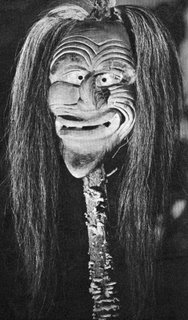
Most curing ceremonies were traditionally held in private in order to achieve the best effect but public ceremonies were held at the Midwinter festival for people who had been cured before. This was considered essential in order to prevent disease from reappearing. Ashes were sprinkled over the people to drive away the demons of disease.

The importance of the false face masks can be understood by describing how they are made. To reinforce the life in the masks, the faces are carved from a living basswood tree but maple, pine, or poplar may also be used. The mask is cut free from the tree only when nearly finished. During the carving, prayers are said to the spiritual forces which are supposed to be represented by the mask and tobacco is burned before the mask in order to please its spirit.

The particular form of the spirit is revealed to the carver through prayers and the burning of tobacco. If the mask is begun in the morning, it is painted red; if its is begun in the afternoon, it is painted black. This is in accordance with the belief that the first False Face made a daily journey following the path of the Sun; thus his face would appear red in the morning as he came from the east and black in the afternoon as he looked back from the west.

Red masks are thought to have more power. There is also a divided mask, painted half red and half black, for a being whose body is torn in two. To the Indian, he stands at the middle of the sky looking south, his red cheek to the east (which suggests life) and recalls the divided body of a patient who may be paralyzed.
The False Face Curing Society was an integral part of the Iroquois belief system. The society always tried to cure as many patients as it could so that they would become new members, for this form of group participation was said to increase its effectiveness as more people became involved in the curing ceremonies. Carvings of False Face masks are made for sale to collectors and museums today, although these are not considered to have spiritual forces.
Sunday, August 6, 2006

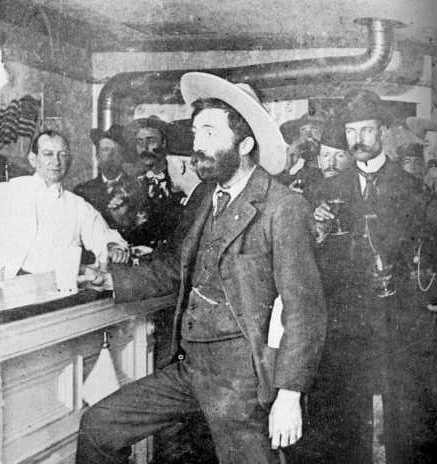
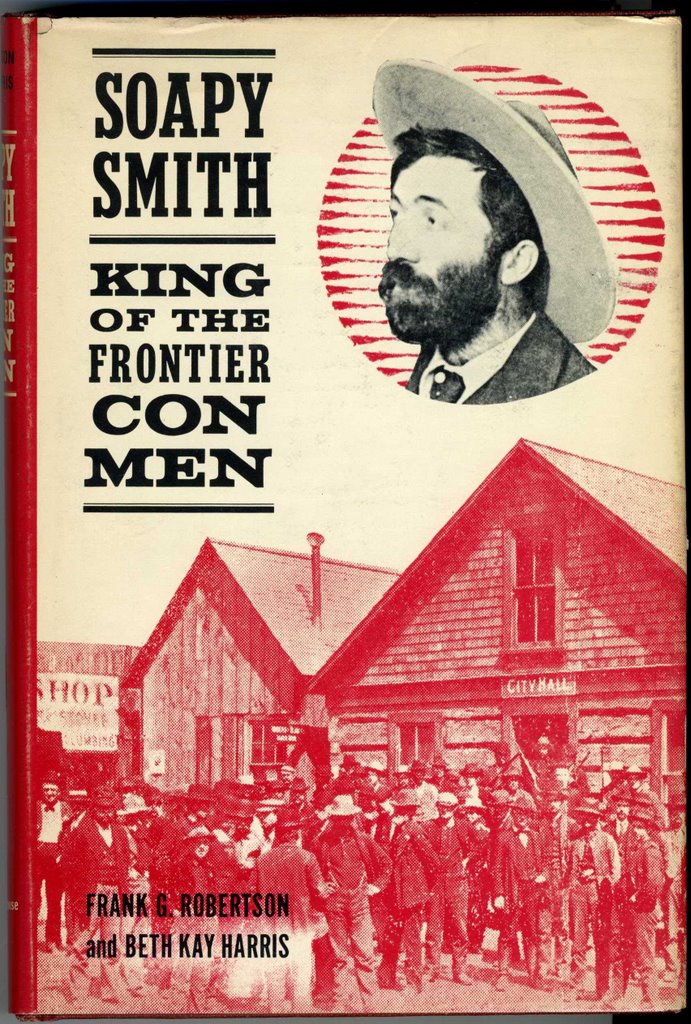
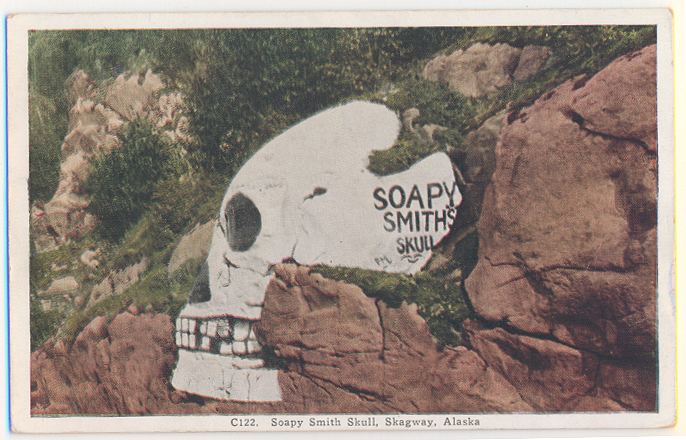
Soapy Smith - King of the Fontier Con Men (1860-1898)

Jefferson Randolph Smith was born in Noonan, Georgia in 1860 to an aristocratic Southern family. Jeff's father, a slave owning lawyer, was financially devastated after the Civil War. The family moved to Texas to find a new life. A solid education was sought for young Jeff, who became an eloquent speaker. Often quoting scriptures and the classics, Jeff's education did the family little good. He found his first job as a cowboy.

Jeff went on his first cattle drive in 1876. After months on the trail, the drive ended up in Abelene, Kansas. Smith wandered the streets and was attracted to a corner where a gambler had set up his shell game. In this game one of three walnut shells hides a pea. The shells are then manipulated and the "sucker", for a price, chooses which shell the pea is under. It didn't take long for Jeff to lose his entire wage to the gambler.

After the loss, Jeff decided that there wasn't any reason for him to slave away on the trail for four months when as a professional gambler he could earn the same wage in minutes. For the next ten years, Jeff wandered the frontier. There were stories that he rode with outlaw gangs. These stories were never proven true. Gambling was in Smith's blood and his ambition was to become the best poker player in the west.

Smith showed up in Leadville, Colorado in 1885. First thing he saw was an old man surrounded by a crowd. Jeff had heard of Old Man Taylor while a boy in Texas. Taylor was known as "King of the Shell Game". With the gift of gab that Jeff possessed, he soon talked Taylor into a partnership in the shell game. It didn't take them long to be making fast, easy money.

One day Taylor showed Smith the "soap trick". Soap was wrapped in paper, and a $100 was wrapped inside one of the bars. The soap was then put on sale at $5 per bar. Of coarse Jeff picked the "loaded" cake of soap and showed off the $100 prize. A stampede followed and they were soon selling 5 cent bars of soap for $5. The suckers were all in hope of easy money!

Jeff moved to Denver with an "improved" soap swindle. He usually set up his little folding table on a street corner near the train station. Smith went out of his way to leave the "locals" alone, and to only fleece the suckers who were passing through town. He entertained the crowds with songs and jokes. Then some of the bars of soap were loaded with $10, $20, and even a few $100 bills. He told the crowd to watch closely, and then gave them the chance to buy a bar of soap for $5. Jeff had formed an organization of con men, who always got the prizes. A complaint was filed with the police, and when he was booked at the police station, the arresting officer couldn't remember Smith's first name but did remember that the swindle involved soap. The officer wrote "Soapy" Smith on the log. The name stuck.

Soapy was the first, and probably the most successful gangster in the west. Before too much time passed Smith opened the Tivoli Saloon and Gambling Hall. Above the door a sign read William Barclay "Bat" Masterson, An Owlhoot in his own right "Caveat Emptor", "Let The Buyer Beware" in Latin. Unfortunately there wasn't anyone in Denver who could read Latin! Bat Masterson was a dealer at the Tivoli.

Soapy developed close ties to the police department and his gangs arrests were reported to him so he could arrange the release. Smith was also a "social worker" handing out free turkeys to the needy on Thanksgiving. He donated heavily to church welfare programs and allowed ministers to hold Sunday services in his saloons.

The silver boom in Creede, Colorado enticed Soapy to move his gambling operation there. It didn't take long for Smith to establish himself as the town's boss and to take over gambling in Creede. Soapy built the Orleans Club on Creede Avenue and organized a makeshift government. He provided protection for his friends with his "government's" backing. Creede finally tired of Soapy's mob rule, and he moved on.

Smith opened a railroad ticket office back in Denver. He advertized tickets to Chicago for $5. When the buyers arrived, they were told that the tickets were not sold every day. They were then shown Soapy's gambling den in the back room.

Colorado governor "Bloody Bridles" Davis H. Waite had about enough of the lawlessness in Denver. He ordered the city to clean itself up or he would do it for them! Soapy became "Colonel" Smith overnight and raised an army to fend off the state militia from city hall. Smith stationed himself in the cupola of city hall with a dynamite bomb and dared the militia to fire on him.

Twenty thousand people turned out to watch the war! The total population of Denver at the time was one hundred six thousand. Federal troops from Fort Logan arrived to act as a peace keeping force. Governor Waite agreed to withdraw the militia in favor of the federal soldiers. Waite also agreed to allow the Colorado Supreme Court to decide the case.

The court issued it's verdict soon after the confrontation, it stated that Waite had the power to remove the commissioners, however the governor was chastised for moving so quickly to bringing in the militia. New commissioners took office, and one of their first actions was to run Soapy Smith out of town.

Soapy drifted around the west after the City Hall War. He went down to Mexico and nearly convinced the Mexican President, Porfirio Diaz, that Mexico needed a foreign legion. Smith got so far as to have a recruiting office set up before the deal fell through.

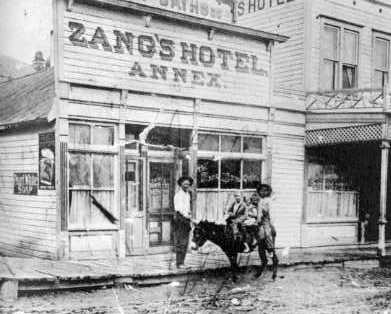
The Yukon Gold Rush of 1897 brought Soapy to Skagway, Alaska. Before long Smith was the "boss" of Scagway. He ran the town with an iron hand for about a year before the citizens had enough and an uprising put an end to his rule. Soapy lost a gunfight on July, 8, 1898 at the age of 37. He's buried in an unmarked grave in a Scagway cemetery.

Visit the Friends of Soapy Smith website.

Friday, August 4, 2006

Tar and Feathering

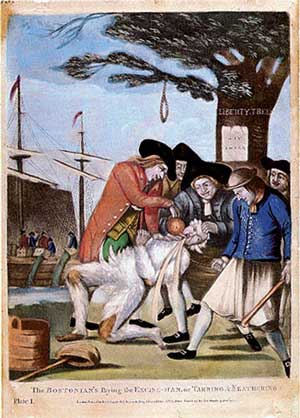
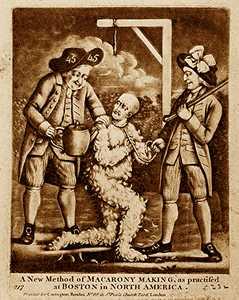
This expression alludes to a former brutal punishment in which a person was smeared with tar and covered with feathers, which then stuck. It was first used as a punishment for theft in the English navy, recorded in the Ordinance of Richard I in 1189, and by the mid-1700s had become mob practice. The figurative usage dates from the mid-1800s.

The practice of smearing a body with tar and then sprinkling the tar with feathers was not original to America. As long ago as 1189, during the reign of Richard the Lionhearted, it was prescribed in the British navy as punishment for theft. But English colonials brought it ashore in North America and made such use of it that it now is thought of as American. It was described as the "present popular punishment for modern delinquents" in 1769.

Richard Thornton's 1912 American Glossary has more than a dozen examples of tar and feather for the years 1769 through 1775, starting with a newspaper account from October 30, 1769. "A person," reported the Boston Chronicle, "was stripped naked, put into a cart, where he was first tarred, then feathered." The Newport Mercury for December 20, 1773, carries a "Notice to the Committee on Tarring and Feathering": "What think you, Captain, of a halter round your neck--ten gallons of liquid tar decanted on your pate--with the feathers of a dozen wild geese laid over that to enliven your appearance?"

During the American Revolution, rebels made examples of British loyalists by tarring and feathering. A memoir of 1774 refers to "the Liberty Boys, the tarring-and-feathering gentlemen." That year a notable victim was "Mr. John Malcomb, an officer of the customs at Boston, who was tarred and feathered, and led to the gallows with a rope about his neck."

The practice was occasionally very violent and resulted in death, but most of the time the purpose was humiliation. John Robert Shaw, in his autobiography from this period, tells a story of a light feathering from New Bedford, Massachusetts:
In this excursion, among other plunder, we took a store of molasses, the hogshead being rolled out and their heads knocked in, a soldier’s wife was stooping to fill her kettle, a soldier slipped behind her and threw her into the hogshead ; when she was hauled out, a bystander then threw a parcel of feathers on her, which adhering to the molasses made her appear frightful enough;–This little circumstance afforded us a good deal of amusement.

The prohibition in the 1791 Bill of Rights against "cruel and unusual punishments" may have helped discourage the practice of tarring and feathering, which seems to have vanished by the end of the nineteenth century. Tar and feather remains in our language today, but only as a figure of speech for public humiliation.

Wednesday, August 2, 2006

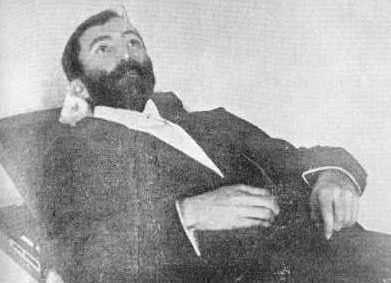
Mike Fink (early 1800's)

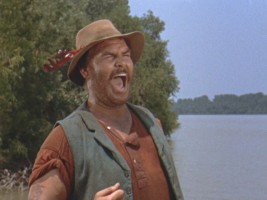
Though he has developed a mythology to rival that of Paul Bunyan, Fink was not a figment of anyone’s imagination. He was the most famous of the keelboatmen who plied the Mississippi and other rivers for two decades until they and their watercraft were displaced by steamboats as the preferred means of moving goods in the early 1800s.
The keelboatmen were the original American anti-heroes -- hard-living, hard-drinking hulks who used their tremendous strength to pole and pull their boats upriver against the current before floating back down.

Born in a log cabin near Pittsburgh around 1780, Miche Phinck, as he learned to spell it from his French Canadian parents, gained notoriety as an Indian scout in the Ohio River Valley and a marksman before settling into keelboating.
His superior physique -– he stood 6-foot, 3 and weighed 180 pounds -– and flair for self-aggrandizement -– he claimed he could “outrun, outshoot, throw down, drag out and lick any man in the country” -- transformed him into an icon for storytellers of the day.

Some of the tales they swapped had him riding a moose like a horse, wrestling alligators and drowning wolves with his bare hands. Fink apparently drifted west after the demise of the keelboats and, by one unconfirmed account, died during a drunken altercation with a trapper friend.

Tuesday, August 1, 2006

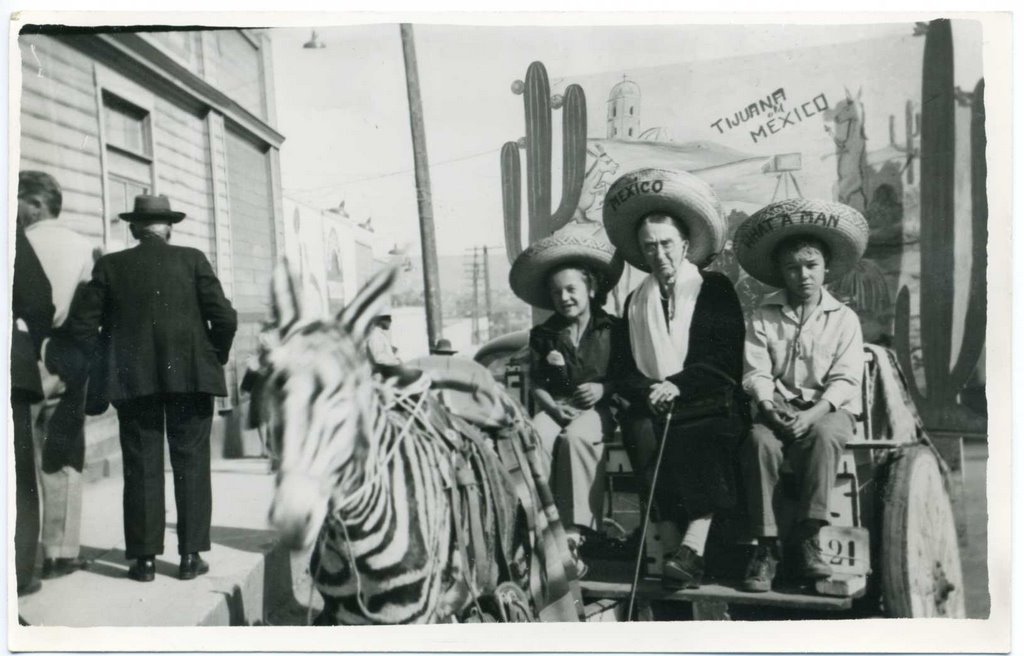
My Great Grandmother, Mother & Uncle - Tijuana, Mexico (1949)


This is my Great Grandmother, my Mother and my Uncle in Tijuana, Mexico. The mule is painted like a zebra. When did they stop doing this down there? I used to go to Mexico three or four times a year when I was younger. I haven't been down there in almost a decade.