In 1835, a group of American colonists, led by Dr. Charles Beale, were camped at Lake Espontosa, a renowned haunted location near what is now Carrizo Springs in southwest Texas. Half a mile away from the Beale group, John Dent and his pregnant wife Mollie Pertul Dent, both from Georgia, had built a brush cabin. Dent had come to trap beaver in the Devil's River area, north of the present day Del-Rio, but was also on the run from the law for the murder of a fellow trapper in Georgia. The Dents were to prove fortunate in their choice of a site distant from the lake. A band of Commanches raided the main Beale camp and massacred most of the inhabitants, afterwards throwing the bodies of the victims and their carts into the lake.
A Haunted LocationEven at this time Espontosa Lake had acquired a reputation for ghostly goings-on, this incident adding to the store of ill-luck and sorrow centering on what, to this day Mexicans consider a haunted location, the name Espantosa meaning 'frightful'.
As Mollie was approaching the end of her pregnancy, the couple were reluctant to travel despite the danger of hostile Indians. One night in May 1835, there was a severe thunderstorm and Mollie went into labor. She appeared to be having problems with the birth so Dent decided to ride westwards for help.

He arrived at a Mexican goat ranch on the Pecos Canyon, and told them desperately about his wife's condition, begging for someone to ride back with him. When the Mexican heard of the camp's location near the haunted Espantosa Lake they were at first unwilling to go, especially as it would be dark when they got there. Eventually Dent managed to persuade the ranchero and his wife to accompany him. But as the Mexicans prepared their horses to leave there was a furious crash of thunder and a bolt of lightning struck Dent from his horse killing him instantly.
After a considerable delay the goat herders mounted up and followed Dent's directions. However, darkness fell before they had got over the divide to Devil's River, thus delaying the search. Finally, at sunrise the next morning they located the Dent's isolated cabin.
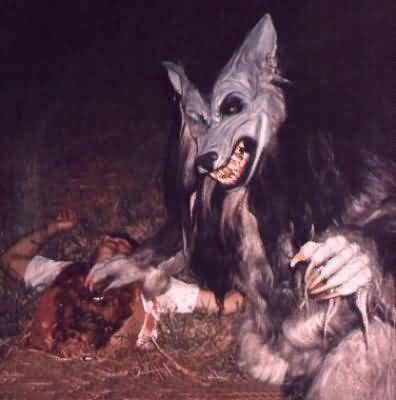
But what they found outside the cabin, in an open brush arbor, was Mollie Dent lying dead, alone. She had apparently died in childbirth, but there was no trace of the baby anywhere. The child was never found, but fang marks on the woman's body and numerous wolf tracks over the area made the goat herders naturally assume that the infant had either been devoured or carried off by lobo wolves.
 First Sighting of the Wolf Girl
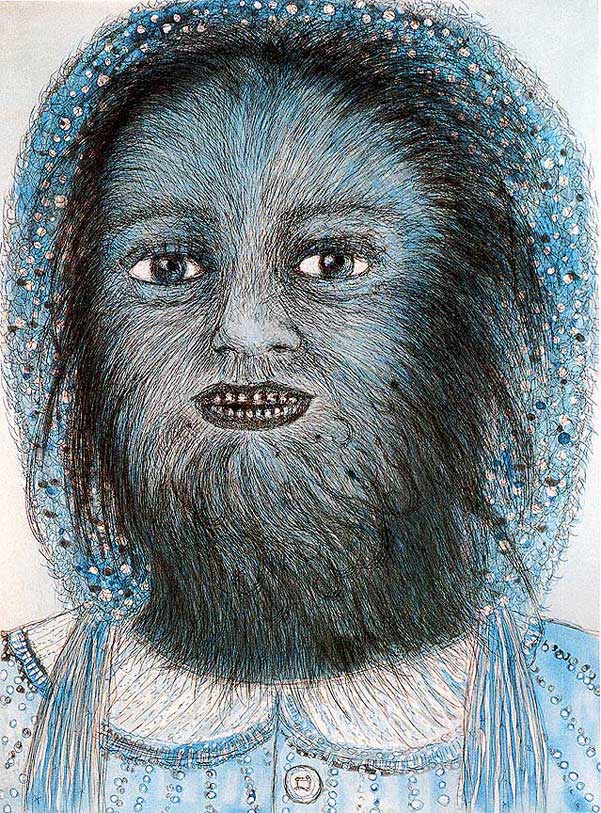
But this was just the beginning of the story. Ten years later, In 1845, a boy living at San Felipe Springs (Del-Rio) reportedly saw 'a creature, with long hair covering its features, that looked like a naked girl' attacking a herd of goats in the company of a pack of lobo wolves. The story was ridiculed by many, but still managed to spread back among the settlements. Around a year after this incident, a Mexican woman at San Felipe claimed she had seen two large wolves and an unclothed young girl devouring a freshly killed goat. She approached close to the group, she said, before they saw her and ran off.
The woman noticed that the girl ran initially on all-fours, but then rose up and ran on two feet, keeping close to the wolves. The woman was in no doubt about what she had seen, and the scattering of people in the Devil's River country began to keep a sharp watch for the girl. There were similar reports by others in the region during the following year and Apache stories told of a child's footprints, sometimes accompanied by hand prints, having been found among wolf tracks in sandy places along the river. A hunt was organised to capture the 'Lobo (or Wolf) Girl of Devil's River' as she had now become known, comprising mainly Mexican vaqueros. On the third day of the hunt the naked girl was sighted near Espantosa Lake running with a pack of wolves.

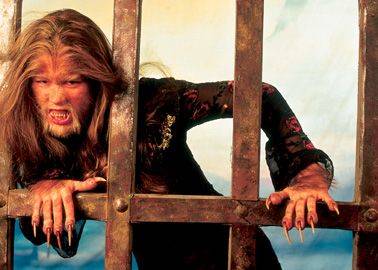
The cowboys managed to separate the girl from her wolf companions and cornered her in a canyon, where she fought like a wildcat clawing and biting frantically to keep her freedom. They finally managed to lasso her to keep her still, but while they were tying her up she began to make frightening, unearthly sounds somewhere between the scream of a woman and the howl of a wolf. As she howled, the monster he-wolf from whom she'd become separated appeared and rushed at her captors. Fortunately one of the cowboys reacted quickly and shot it dead with a pistol, at which the wolf girl fell into a faint. Securely bound, the men were now able to examine the girl and noted that despite a body covered in hair and her wild mannerisms, her appearance was human. Her hands and arms were well muscled but not out of proportion, and she lacked the ability to speak, only making deep growling noises. She moved smoothly on all fours, but was rather awkward when made to stand up straight.
The girl was put on a horse and taken to the nearest ranch, an isolated two-roomed shack amid the desert wilderness. She was put in one of the rooms and unbound, the cowboys offering her a covering for her body and food and water, but she refused, cowering in the darkest corner. They then left her alone for the night, locking the door and posting a guard outside. The only other opening in the room was a small boarded up window.
 Ghostly Cries
But as night fell the cowboys heard terrifying howls coming from the wolf girl's room. The strange cries carried through the still night air, unsettling her captors and soon finding answers from among the wolf pack in the wilderness beyond the shack. Soon there were long deep howls coming from all sides as the pack drew closer to the house, and occasionally strange howling screams from the girl answering them from inside her dark room. Suddenly the large pack of wolves charged into the corrals, attacking the goats, cows and horses and bringing the cowboys outside shooting and yelling to drive them away. In all the confusion the wolf girl managed to tear the planks from the window and escape into the night. The howls soon abated and the wolves crept back into the wilderness. The next day not a trace of the girl could be found.
Though there were a few unverified reports in the following years of a young hair-covered girl being seen with a wolf pack in the area, no one ever came in close contact with her. Meanwhile gold had been discovered in California and westward travel had increased significantly. In 1852 a surveying party of frontiersmen searching for a new route to El Paso were riding down to the Rio Grande at a bend far above the mouth of Devil's River. They were almost at the water's edge when they saw at close range, sitting on a sand bar, a young woman suckling two wolf cubs. Suddenly she saw them, quickly grabbed the pups and dashed into the breaks at such a rate that it was impossible for the horsemen to follow.
The girl would have been seventeen years-old that year. After that she disappeared into the wilderness forever. It is impossible now to know what became of Mollie Dent's daughter, presuming that's who the wolf girl was. There were subsequent reports of 'human-faced' wolves in the area right up until the 1930s, and author L.D. Bertillion (see sources below), wrote in 1937, 'during the past forty years I have in the western country met more than one wolf face strongly marked with human characteristics'.
 The Ghost of Devil's River
However, the Wolf Girl of Devil's River does seem to live on in subtler forms. Her 'ghost' has apparently been seen in the old San Felipe Springs area beside the banks of Devil's River. In 1974 (the same year as the Delphos wolf girl in Kansas), a hunter in this area claimed to have seen her again, in the form of a white apparition which vanished before his eyes.
Back in the autumn of1835, when John and Mollie Dent had newly arrived in Texas, Mollie wrote her mother an odd letter. It said merely -
'Dear Mother,
The Devil has a river in Texas that is all his own and it is made only for those who are grown.
Yours with love
Mollie'.


 In 1835, a group of American colonists, led by Dr. Charles Beale, were camped at Lake Espontosa, a renowned haunted location near what is now Carrizo Springs in southwest Texas. Half a mile away from the Beale group, John Dent and his pregnant wife Mollie Pertul Dent, both from Georgia, had built a brush cabin. Dent had come to trap beaver in the Devil's River area, north of the present day Del-Rio, but was also on the run from the law for the murder of a fellow trapper in Georgia. The Dents were to prove fortunate in their choice of a site distant from the lake. A band of Commanches raided the main Beale camp and massacred most of the inhabitants, afterwards throwing the bodies of the victims and their carts into the lake.


 As she puts it, Ann Ball has a split personality. All day in her work managing a Houston security guard company she plays a perpetual game of Cops and Robbers, carries a gun, and cusses like a sailor. At night she creeps home and writes Catholic books and articles. Her specialties are the lives of the modern saints and Catholic heritage and tradition. She has had a love affair with Mexico and its people since she was young. A pure Texan, her friends tease her and call her a Mexican at heart. At home with five cats, she enjoys reading, gardening, and messing around with the herbs she grows. The following is from Ann Ball's Website: